AI Agents vs Agentic AI: The Difference in Simple Words
Two years ago nobody outside a research lab said "agent" at dinner. Now every product page shouts it, and a second phrase has crept in beside it: agentic AI. If you have felt a small flash of doubt about whether ai agents vs agentic AI describe two different things or the same thing wearing two hats, you are not slow. You are paying attention. The honest answer is that they are related, they are not identical, and the marketing around both has blurred the line on purpose. I have spent enough time building small agents and reading enough launch posts to have a strong opinion here, and I want to hand you a version of the difference that survives contact with a real product demo. No jargon walls. Just the working definitions, a comparison you can point at, and the parts where I think the hype has run ahead of what the software actually does.
The quick difference between AI agents and agentic AI
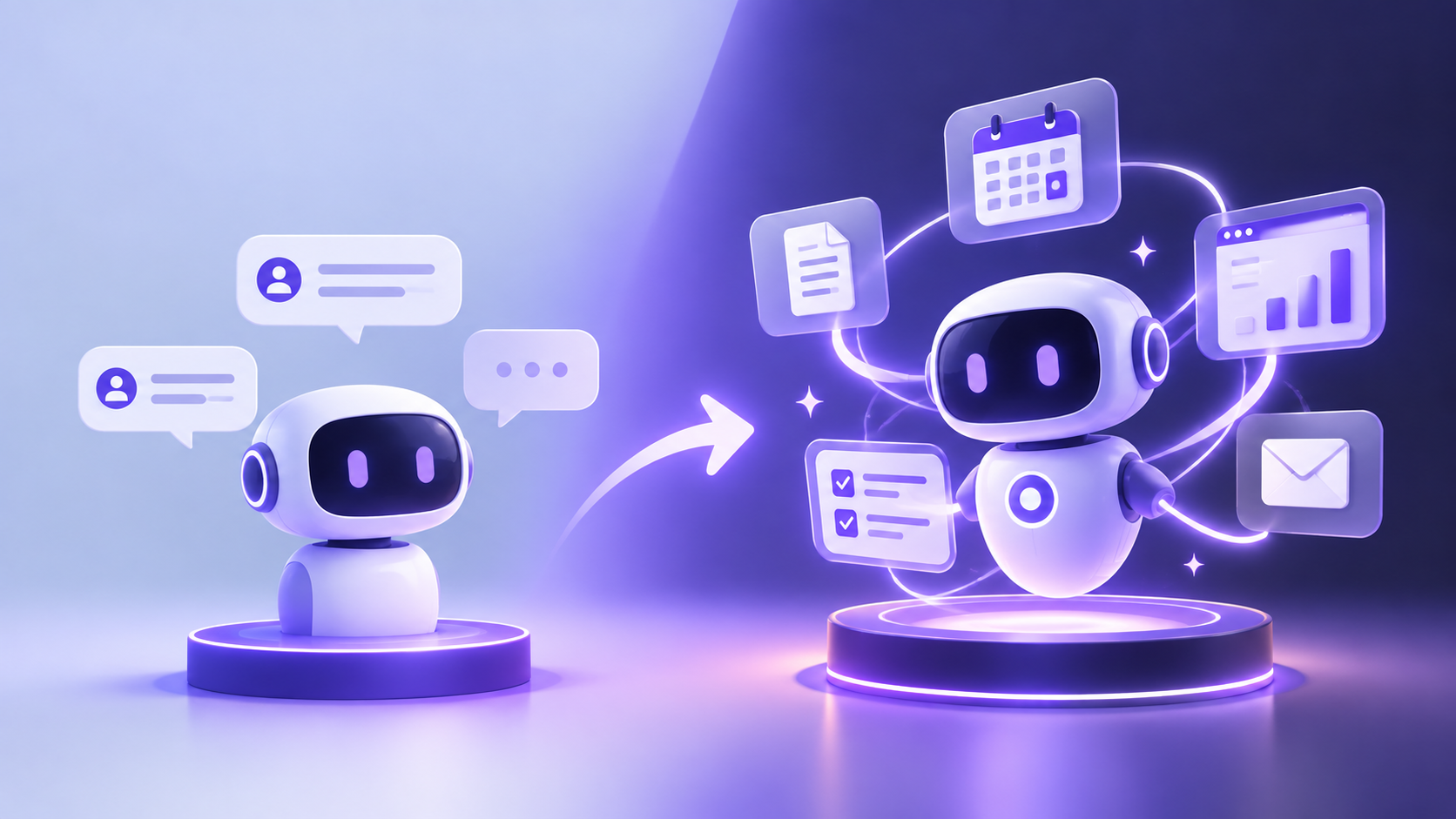
Let me answer first and explain second, because that is how I wish more people wrote about this. An AI agent is a single program. Agentic AI is a way of building systems. One is a noun you can hold; the other is an adjective that describes behavior. When someone says "we built an agent," they usually mean one focused worker: give it a goal, it reasons with a language model, it reaches for tools, it comes back with a result. When someone says "our platform is agentic," they are describing a bigger claim, that the software plans across steps, decides what to do next, remembers context, and keeps going with some independence.
I find it helps to think in scale. A single agent is one employee who can use a laptop and a phone. Agentic AI is the whole team plus the process they follow. You can have a great employee without a team, and you can design a bad process even with good people. That gap is exactly why the two words are not interchangeable, even though they get swapped constantly. Here is the comparison I keep coming back to when I want the difference between AI agent and agentic AI on one screen.
| Dimension | AI agent | Agentic AI |
|---|---|---|
| What it is | A single program or worker | A system or design approach |
| Scope | One task at a time | A whole goal with many steps |
| Building block | LLM plus tools plus a loop | One or more agents plus planning and memory |
| Autonomy | Limited, usually one job | Higher, decides its own next steps |
| Structure | Often single agent | Often multi-agent or multi-stage |
| Memory | Short, task-scoped | Longer, carried across steps |
| Human role | You trigger and review | You set goals and guardrails |
| Everyday label | "an agent" | "an agentic workflow or platform" |
If you only take one line from this whole piece, take this one: every agentic system is made of agents, but a lone agent is not automatically an agentic system. That single sentence resolves most of the arguments I see online.
What is an AI agent
An AI agent is a program that takes a goal, thinks about it using a large language model, and then uses tools to act on the world instead of only producing text. That last part is the whole point. A plain chatbot reads your message and writes a reply. An agent reads your message, decides it needs to look something up, calls a search tool, reads the result, decides whether that was enough, and only then writes back. The loop of think, act, observe, and repeat is what separates an agent from a model you simply chat with.
To make an AI agent you generally need three ingredients. First, a reasoning engine, which is the language model that decides what to do. Second, a set of tools, which might be web search, a calculator, a code runner, a database query, or an API for sending email. Third, a loop that lets the model call a tool, see the output, and choose the next move. If you want the fuller build story, I wrote a hands-on walkthrough on how to build an AI agent free that starts from exactly these parts. The language model at the center is the same kind of system I break down in this primer on what a large language model is, so the agent is really an LLM with hands.
Here is a concrete AI agent meaning you can picture. Say you ask an agent to find the three cheapest direct flights from Delhi to Singapore next month. A chatbot would guess or tell you to check a website. An agent would call a flight search tool, read the returned list, sort by price, filter for direct routes, and hand you three options with links. It used a tool, reacted to real data, and finished a task. That is the shape of an agent. It is focused, it is bounded, and when it works it feels less like typing and more like delegating.
My honest opinion after building a few of these: a single well-scoped agent is more useful today than any sprawling autonomous setup. Narrow beats grand. An agent that does one job reliably will earn its place, while a system that promises to run your whole life tends to wobble the moment reality gets messy.
One more thing about the word "tool," since it does so much work in this definition. A tool is anything the agent can call to affect the world or fetch fresh information. Search engines, spreadsheets, code interpreters, calendars, payment APIs, internal company databases, all of these count. The model itself knows nothing about right now; its knowledge is frozen at training time. Tools are how the agent reaches into the live world and how it stops guessing. When you hear that an agent has "tool use," picture giving a very well-read intern access to a phone, a browser, and your files. Suddenly the intern can do things, not just talk about them, and that shift from talking to doing is the entire reason the word agent exists.
What is agentic AI
So what is agentic AI, then, if an agent is already doing all that? Agentic AI is the broader approach where the software behaves with initiative across a whole goal, not just a single task. It plans, it breaks a goal into steps, it picks tools, it checks its own output, it holds memory of what it has done, and it decides what to do next without waiting for you to click through every stage. You can build agentic AI with one clever agent that loops many times, or with several agents that hand work to each other. The label describes the behavior and the design, not a specific piece of code.
Picture the same travel task, but bigger. Instead of "find three flights," you say "plan a five day trip to Singapore under a set budget." An agentic system would break that into subgoals: find flights, find a hotel near the areas I like, build a day-by-day plan, check the total against the budget, and revise if it goes over. It might spin up a flights agent, a lodging agent, and a planner that stitches the pieces together. It keeps a running memory of choices so the hotel matches the flight dates. It notices when the budget breaks and loops back to fix it. That planning, reflecting, and self-correcting across steps is the heartbeat of agentic AI. If you want a deeper dive on the concept alone, I put together a full explainer on what is agentic AI that goes past the surface.
The reason this matters is autonomy with structure. Agentic AI is not just "an agent that runs longer." It is an agent, or a group of them, wrapped in a process that decides, remembers, and adjusts. When people at OpenAI or Anthropic talk about the future of software doing real work, this is the layer they mean. Not a smarter autocomplete, but a system that owns an outcome and figures out the middle by itself.
I want to slow down on the word "reflect," because it is the part people skip and it is what separates a real agentic system from a script with a fancy name. Reflection means the software looks at its own output and judges it before moving on. Did that search actually answer the question? Does this draft contradict the budget? Is this fact backed by a source? A plain automation runs its steps whether or not they made sense. An agentic system pauses, grades itself, and reroutes when the grade is bad. That self-check is slow and imperfect, but it is the closest thing these systems have to judgment, and it is why a well-built agentic workflow can recover from a bad step instead of blindly carrying the mistake forward into everything that follows.
The real differences that matter
Definitions are nice, but the difference between AI agent and agentic AI gets clearer when you look at four practical dimensions. These are the ones I actually check when I read a product claim and try to guess what is really under the hood.
Scope: one task or a whole goal
An AI agent is scoped to a task. Summarize this document. Answer this support ticket. Pull today's numbers. Agentic AI is scoped to a goal that contains many tasks, and the system itself figures out the task list. The moment software starts writing its own to-do list instead of running yours, you have crossed from a single agent into agentic territory. Scope is the cleanest tell.
Autonomy: how much it decides alone
Autonomy is a slider, not a switch. A basic agent has low autonomy: you trigger it, it does one thing, you review. Agentic AI turns that slider up. It chooses which tools to call, in what order, and when it is done. It can decide that a first attempt failed and try a different path. More autonomy means more power and, I would argue, more risk, because a system that acts on its own can be confidently wrong on its own too.
Single agent versus multi-agent
Many AI agents work solo. Agentic AI often uses several agents that specialize and pass work between them, a pattern the community calls multi-agent. One agent researches, one writes, one checks the facts. Frameworks like LangChain grew popular partly because they make wiring these pieces together less painful. Multi-agent is not required for a system to be agentic, but it is a common sign you are looking at agentic design rather than a lone worker.
Planning and memory
The last dimension is the quiet one that does most of the heavy lifting. A single agent usually has short memory, scoped to the task in front of it. Agentic AI carries memory across steps so choices stay consistent, and it plans ahead instead of reacting move by move. Good memory is why an agentic trip planner does not book a hotel for the wrong dates. If you want to understand how systems keep the right information in front of the model without drowning it, my write-up on what is context engineering covers the discipline that makes this work in practice.
My contrarian take sits right here, so I will say it plainly. The terms ai agents vs agentic AI are used interchangeably far more often than they should be, and both are frequently marketed as more capable than they actually are. A demo that runs in a clean sandbox is not the same as a system you can trust with a real budget or a real inbox. I have watched impressive launch videos that quietly failed the second task I threw at them. Treat the labels as descriptions of ambition, not proof of reliability.
Where the two terms overlap and why people confuse them
Given all that, why does agentic AI vs AI agents cause so much confusion? Because the overlap is real and large. Every agentic system is built from agents, so the moment you describe an agentic platform, you are also describing agents. And a single agent that runs a long loop, calls many tools, and keeps some memory starts to look agentic even though it is technically one program. The boundary is a gradient, not a wall, and honest engineers will admit the line moves depending on who is drawing it.
Marketing makes it worse, and I do not say that to be cynical. When "agent" became the hot word, everything got relabeled an agent overnight. When "agentic" started sounding more advanced, the same features were rebranded again. So you get two products with near-identical capabilities, one calling itself an AI agent and the other calling itself agentic AI, purely based on which word tested better. The prompt techniques you use to steer either one are the same craft I cover in my guide to prompt engineering, which is a reminder that the label on the box changes faster than the thing inside it.
Here is the mental shortcut I use to cut through it. Ask one question: does this software decide its own steps, or do I? If I hand it a goal and it writes and runs its own plan, that is agentic behavior. If I hand it a task and it does that one task, that is an agent. The word on the pricing page does not decide the answer. The behavior does. I trust that test far more than any brand's chosen vocabulary.
Real examples: a research agent versus an agentic workflow
Abstract definitions slide off the brain, so let me put two concrete systems side by side. Both use a language model. Both use tools. One is a single agent; the other is an agentic workflow. The difference will feel obvious once you see them move.
First, the research agent. You give it a question: "What did the major AI labs ship this quarter?" The agent uses a language model to plan a couple of searches, calls a web search tool, reads the results, pulls out the relevant facts, and writes you a tidy summary with sources. It runs once, top to bottom, and stops. It is powerful and genuinely useful, and it is still a single agent. One task, one loop, one clean output. Tools like ChatGPT's built-in agent features and similar assistants live mostly here, and honestly this covers a huge share of what most people need day to day.
Now the agentic workflow. You give it a goal: "Produce a weekly competitive brief, publish it, and flag anything urgent to me." The system plans the whole job. A research agent gathers the news. A second agent clusters it into themes. A writer agent drafts the brief. A checker agent verifies the claims against sources. A publishing step posts it, and a monitor decides whether anything is urgent enough to ping you directly. Memory ties it together so the brief references last week's items, and if the fact-checker rejects a claim, the system loops back rather than shipping it. No single click from you in the middle. That coordination, memory, and self-correction is what makes it agentic rather than just a smarter search.
Notice the family resemblance. The research agent is literally one of the workers inside the agentic workflow. That is the overlap made visible. The agent is a part; the agentic system is the whole assembly line. Once you see one living inside the other, the ai agents vs agentic AI question stops feeling like a riddle and starts feeling like the difference between a wrench and a workshop.
I would add one caution from watching these systems in the wild. The agentic workflow looks more impressive on a slide, but it is also harder to trust, because every extra agent and every extra handoff is another place a small error can slip in and quietly grow. The research agent, boring as it sounds, is the one I would deploy first for a real team. It does a clear job, it finishes fast, and when it is wrong you can see exactly where. Complexity is a cost, not a badge, and I wish more product pages treated it that way instead of racing to add agents nobody asked for.
Honest limits: what agents still get wrong in 2026
I want to be straight with you, because most explainers stop at the shiny part. As of 2026, both AI agents and agentic AI are impressive and unreliable at the same time, and pretending otherwise does nobody any favors. The demos are real, and so are the failures, and you should plan for both.
The first problem is compounding errors. A single agent might be right eighty or ninety percent of the time on a step. String ten steps together in an agentic workflow and those small error rates multiply, so a long autonomous run can drift off course in ways that are hard to notice until the end. More steps mean more chances to be wrong, and the system rarely tells you which step went sideways.
The second problem is confident mistakes. An agent will take a wrong action with the same calm tone it uses for a right one. It does not feel doubt. When it books the wrong date or emails the wrong person, it reports success just as cheerfully. That is why I never let an agent take an irreversible action, spend money, or message real people without a human check in the loop. Autonomy is a gift you hand out slowly.
The third problem is brittleness outside the demo. Agentic systems that dazzle in a controlled setting often stumble when a website changes its layout, a tool times out, or a task needs common sense the model does not have. Real environments are messier than test cases, and the gap between "worked in the video" and "works on my actual account" is still wide. My rule of thumb is simple: trust an agent with reversible, low-stakes work first, watch how it fails, and expand its leash only after it has earned it. Reliability is the real frontier, not raw capability, and the labs at Anthropic and elsewhere say as much in their own guidance on building effective agents.
Do beginners really need to care
You might be wondering whether any of this matters if you are not building software. My answer is a qualified yes. You do not need to memorize architecture diagrams, but knowing the difference between AI agent and agentic AI protects you in two practical ways, and both save you money and frustration.
First, it makes you a sharper reader of product claims. When a tool calls itself agentic, you now know to ask the real question: does it actually plan and act across steps, or is it a single agent with a bigger marketing budget? That one question deflates a lot of hype. Second, it helps you pick the right tool for the job. For most everyday needs, a good single agent that summarizes, searches, or drafts is plenty, and it will be faster and more reliable than a grand autonomous system you have to babysit. Reach for agentic setups when the goal genuinely has many moving parts that must coordinate.
If you are a beginner who wants to actually try building something, start small. Make one agent that does one task well. You will learn more from a working single agent than from a half-broken swarm, and you will understand agentic AI far better once you have felt what a single agent can and cannot do. Curiosity plus a small project beats reading ten more explainers, including this one. Go build the wrench before you try to build the workshop. The concepts will click into place the first time your own little agent surprises you by doing something you did not spell out step by step, and that small moment teaches more than any definition on a page ever could.
Frequently asked questions
Is agentic AI just a fancy name for AI agents?
Not quite, though the words overlap. Agentic AI describes a system or approach that plans, acts, remembers, and self-corrects across a whole goal. An AI agent is a single program that completes one task. Every agentic system is built from agents, but a lone agent is not automatically an agentic system.
What is the simplest definition of an AI agent?
An AI agent is a language model with tools and a loop. It takes a goal, reasons about it, calls tools to act in the real world, reads the results, and repeats until the task is done. The tool use and the loop are what separate it from a plain chatbot.
What is agentic AI in one sentence?
Agentic AI is software that decides its own steps toward a goal, using one or more agents that plan, use tools, check their work, and keep going with some autonomy instead of waiting for you to click through every stage.
Do I need coding skills to use AI agents?
To use them, usually not. Many assistants and platforms give you agent features through a simple interface. To build custom ones, some coding helps, though beginner-friendly tools keep lowering the bar. Starting with a single small agent is the gentlest on-ramp.
Are AI agents safe to trust with important tasks?
Trust them with reversible, low-stakes work first. As of 2026 both agents and agentic systems make confident mistakes, so keep a human check on anything that spends money, sends messages, or cannot be undone. Expand their autonomy only after they earn it.
Which should a small business start with, an agent or agentic AI?
Almost always a single agent. Pick one repetitive task, such as drafting replies or summarizing reports, and deploy one reliable agent for it. Move to agentic workflows only when a goal clearly needs several steps coordinated, because the extra power comes with extra fragility.
Do OpenAI and Anthropic mean the same thing by these terms?
Roughly, yes, though each frames it in its own language. Both treat an agent as a model that uses tools in a loop, and both use agentic to describe systems that plan and act toward goals. The core ideas match even when the marketing words differ.
Recommended Blogs
What is a large language model
If this cleared up the ai agents vs agentic AI question, the best next step is to keep learning in plain language. Head to unrot.co for more no-nonsense explainers that turn AI buzzwords into things you can actually use.