AI Interview Questions and Answers for Freshers (2026)
I have sat on both sides of the table for AI interviews, and here is the pattern I keep seeing. Freshers walk in with a memorized definition of machine learning, get one follow up question, and freeze. The definition was never the test. The follow up was.
These AI interview questions for freshers are the ones that actually get asked in 2026, from campus placements in Pune and Hyderabad to startup Zoom rounds. I have grouped them the way a real interview flows, from AI basics to machine learning core, then deep learning, then the part that did not exist in fresher interviews three years ago: generative AI, large language models, and RAG.
Every answer here is written so you can say it out loud in an interview without sounding like a textbook. Short, specific, and honest. If you want the full foundation behind these answers, our guide on how to learn AI from scratch pairs well with this list. Let me get into the questions.
How AI interviews changed in 2026
AI interviews for freshers in 2026 test applied understanding, not just definitions. The single biggest shift is that recruiters now expect you to talk about large language models, hallucinations, prompt engineering, retrieval augmented generation, and AI agents, alongside the classic machine learning fundamentals. Two years ago you could clear a round by defining overfitting. Now you get asked how you would reduce hallucinations in a chatbot you shipped.
I think this is fair, and I will say something that annoys a lot of coaching centers: memorizing fifty definitions is close to useless in 2026. Interviewers can smell a rehearsed answer in one sentence. What moves the needle is one project you can defend and one recent model or tool you have actually used, like ChatGPT, Claude, or an open model you ran locally.
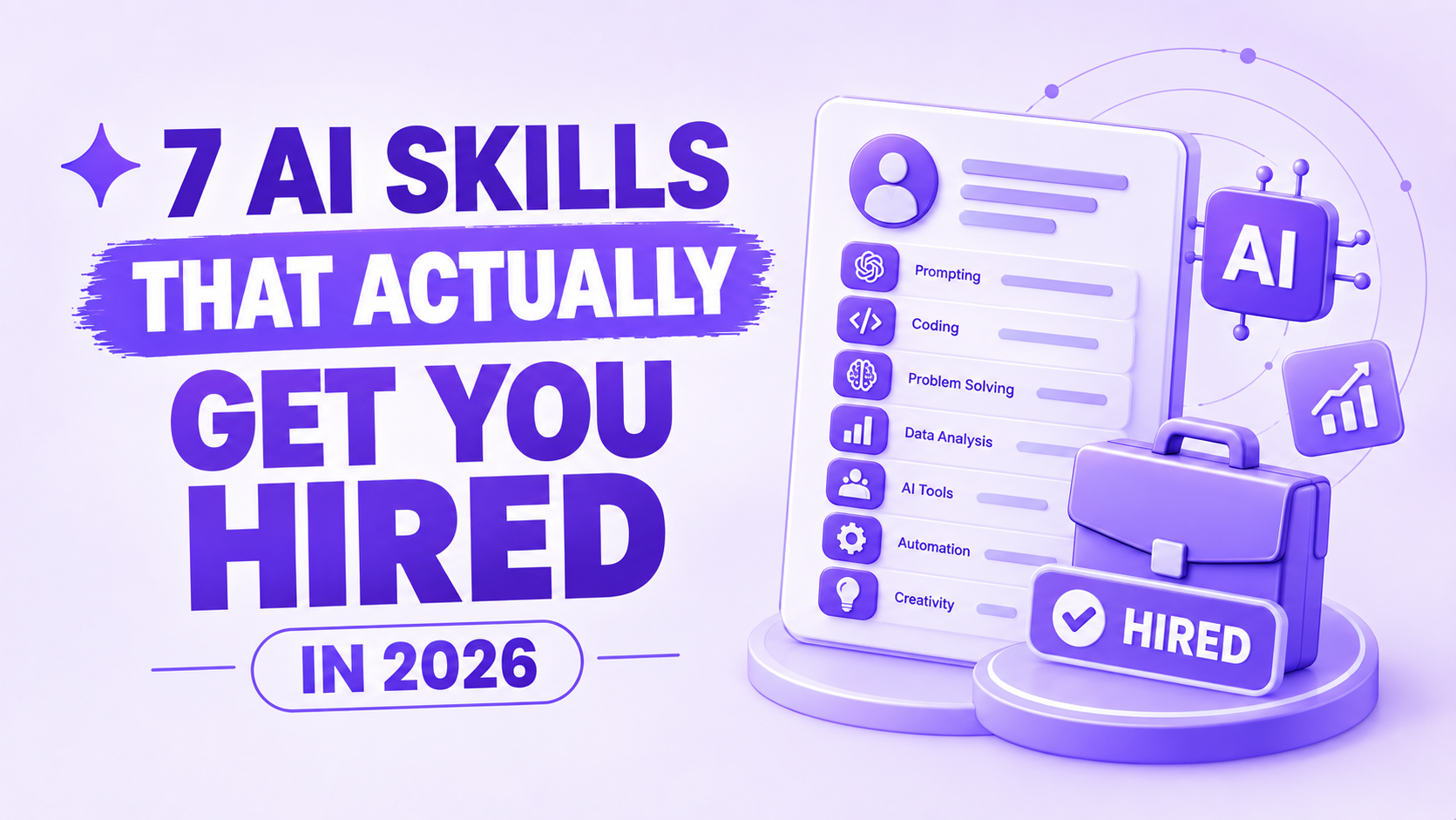
Responsible AI has also entered fresher rounds. You may be asked about bias in training data, privacy, or why a model should not be deployed in a high stakes setting without human review. The freshers who get hired treat AI as something they build with, not a topic they revise the night before. If you know which AI skills get you hired, you can weight your prep toward what interviewers reward.
AI basics interview questions
AI basics questions filter out candidates who never built intuition. Get these crisp and you buy trust for the harder rounds.
1. What is artificial intelligence?
Artificial intelligence is the field of building systems that perform tasks that normally need human intelligence, like understanding language, recognizing images, making decisions, or predicting outcomes. As a fresher I would add one concrete example: a spam filter that learns which emails are junk is AI, because it improves from data instead of following fixed rules written by a person. Keep it to two sentences and give the example. The example is what makes the answer land.
2. What is the difference between AI, machine learning, and deep learning?
AI is the broad goal of intelligent behavior, machine learning is a subset where systems learn patterns from data instead of being explicitly programmed, and deep learning is a subset of machine learning that uses multi layer neural networks to learn from large, unstructured data like images and text. Think of three circles nested inside each other, with AI as the largest. A quotable way to say it: all deep learning is machine learning, and all machine learning is AI, but not the reverse.
3. What are the types of AI?
By capability, AI is grouped into narrow AI, general AI, and super AI. Narrow AI does one task well and is everything we use today, from Google Maps to ChatGPT. General AI would match a human across any task and does not exist yet, and super AI would exceed humans and is theoretical. Freshers should be clear that every real system in production in 2026 is narrow AI, no matter how impressive it looks.
4. What is the difference between supervised, unsupervised, and reinforcement learning?
Supervised learning trains on labeled data, so the model learns from examples where the right answer is given, like photos tagged cat or dog. Unsupervised learning finds structure in unlabeled data, like grouping customers into segments without being told the groups. Reinforcement learning trains an agent through rewards and penalties as it interacts with an environment, which is how game playing and robotics systems learn. Name one example per type and you sound like you have used them.
Machine learning core interview questions
The machine learning core is where most fresher interviews are won or lost. If you master overfitting and the bias variance tradeoff, you can reason your way through half the follow ups. My honest opinion: these six answers matter more than any deep learning trivia.
5. What is overfitting and how do you prevent it?
Overfitting happens when a model learns the training data too well, including its noise, so it performs great on training data but poorly on new, unseen data. You prevent it with more training data, simpler models, regularization like L1 or L2, dropout in neural networks, and cross validation. The one line I would say in an interview: a model that scores 99 percent on training and 70 percent on test data is overfitting, and the gap is the tell.
6. What is underfitting?
Underfitting is the opposite problem, where a model is too simple to capture the pattern in the data, so it performs poorly on both training and test sets. It usually means the model needs more features, more complexity, or more training. If overfitting is memorizing the answers without understanding, underfitting is not studying enough. Interviewers love when you tie the two together instead of defining each in isolation.
7. Explain the bias variance tradeoff.
Bias is error from wrong assumptions that make a model too simple, and variance is error from a model being too sensitive to the training data. High bias causes underfitting, high variance causes overfitting, and the tradeoff is that reducing one often increases the other. The goal is the sweet spot in the middle where total error is lowest. A clean line to remember: bias is being consistently wrong, variance is being wildly inconsistent.
8. What is gradient descent?
Gradient descent is the optimization algorithm that trains most machine learning models by minimizing a loss function. It repeatedly adjusts the model parameters in the direction that reduces the error, taking steps whose size is set by the learning rate. Picture walking downhill in fog by always stepping in the steepest downward direction until you reach the bottom. If the learning rate is too high you overshoot the valley, and if it is too low training takes forever.
9. What is the difference between batch, stochastic, and mini batch gradient descent?
Batch gradient descent uses the whole dataset for each update, which is stable but slow. Stochastic gradient descent updates on one example at a time, which is fast and noisy. Mini batch gradient descent uses small groups of examples, usually 32 to 256, and is the standard because it balances speed and stability. Most freshers only know plain gradient descent, so naming mini batch as the practical default sets you apart.
10. Why do we split data into training and test sets?
We split data so we can measure how a model performs on data it has never seen, which is the only honest estimate of real world performance. A common split is 70 or 80 percent for training and 20 or 30 percent for testing, often with a separate validation set for tuning. Without a test set, you have no way to catch overfitting. The rule I repeat: never let your model see the test data during training, or your accuracy is a lie.
11. What evaluation metrics would you use for a classification model?
For classification I would use accuracy, precision, recall, and F1 score, and I would choose based on the problem. Accuracy is fine for balanced data, but for imbalanced data like fraud detection, recall and precision matter far more, because 99 percent accuracy is worthless if you miss every fraud case. Precision asks how many predicted positives were correct, recall asks how many actual positives you caught, and F1 balances the two. Mentioning imbalanced data unprompted is a strong signal to interviewers.
Deep learning and neural network questions
Deep learning questions test whether you understand the machinery behind modern AI. You do not need to derive backpropagation as a fresher, but you must explain the intuition without hiding behind jargon.
12. What is a neural network?
A neural network is a model made of layers of connected nodes, called neurons, that pass signals forward and adjust their connection weights during training to learn patterns. It has an input layer, one or more hidden layers, and an output layer. Loosely inspired by the brain, it maps inputs to outputs by learning the right weights through gradient descent and backpropagation. When there are many hidden layers, we call it a deep neural network, which is where deep learning gets its name.
13. What is an activation function and why is it needed?
An activation function decides whether and how strongly a neuron fires, and it introduces non linearity so the network can learn complex patterns. Without it, stacking layers would collapse into a single linear model that cannot handle real world data. Common ones are ReLU, which is the default in most modern networks, plus sigmoid and tanh. The one line: without activation functions, a deep network is just expensive linear regression.
14. What is the difference between a CNN and an RNN?
A convolutional neural network, or CNN, is built for grid data like images, using filters that detect features such as edges and shapes, which is why it dominates computer vision. A recurrent neural network, or RNN, is built for sequences like text or time series, because it carries a memory of previous steps. In one line: use a CNN for images and an RNN for sequences, though transformers have now replaced RNNs for most language tasks.
15. What is a transformer?
A transformer is a neural network architecture introduced in 2017 that uses a mechanism called attention to weigh the importance of different parts of the input, and it powers almost every modern large language model. Unlike RNNs, it processes an entire sequence at once instead of step by step, which makes it far faster to train on huge datasets. Every model you have heard of, from GPT to Claude to Gemini, is a transformer under the hood. Knowing this connects the classic and generative halves of the interview.
Generative AI and LLM interview questions
Generative AI questions are the newest and, in my opinion, the most decisive part of a 2026 fresher interview. Companies build with LLMs now, so they want freshers who understand them beyond the hype. If you go deeper on one topic here, make it retrieval augmented generation.
16. What is a large language model?
A large language model, or LLM, is a neural network trained on massive amounts of text to predict the next token, which lets it generate human like language, answer questions, write code, and summarize. Models like GPT, Claude, and Gemini are LLMs with billions of parameters. The core idea is simple even if the scale is huge: it predicts what comes next, one token at a time. For a fuller breakdown, our explainer on the large language model covers how training works end to end.
17. What is a token?
A token is the basic unit of text an LLM processes, usually a word or a piece of a word, so the word interviewing might split into inter, view, and ing. Models have a context window measured in tokens, which limits how much text they can consider at once. As a rough guide, 1,000 tokens is about 750 English words. Freshers who mention tokens and context windows sound like they have actually used the API, not just the chat box.
18. What is a hallucination in an LLM?
A hallucination is when a language model generates text that sounds confident and fluent but is factually wrong or made up, like inventing a citation or a statistic. It happens because the model predicts plausible text, not verified truth. You reduce hallucinations with retrieval augmented generation, grounding the model in real documents, and asking it to cite sources. My honest take: any fresher who claims LLMs are always accurate has not used one seriously, and interviewers notice.
19. What is prompt engineering?
Prompt engineering is the practice of writing clear, structured instructions to get better and more reliable outputs from an LLM. Techniques include giving examples, called few shot prompting, asking the model to reason step by step, and setting a clear role and format. It matters because the same model can give a weak or a strong answer depending entirely on the prompt. If you want a working system, our guide to prompt engineering shows the patterns that hold up in production.
20. What is retrieval augmented generation, or RAG?
RAG is a technique that connects an LLM to an external knowledge source, so before answering, the system retrieves relevant documents and feeds them to the model as context. It solves two big problems: hallucinations and outdated knowledge, because the model answers from your actual data instead of only its training. A support bot that pulls from your company docs before replying is RAG. This is the single most asked generative AI topic in 2026 fresher interviews, so read our explainer on what is RAG before you sit for one.
21. What is the difference between fine tuning and RAG?
Fine tuning retrains a model on your own data so the knowledge is baked into its weights, while RAG keeps the model fixed and supplies fresh information at query time from an external source. Fine tuning is better for teaching a style or a specialized skill, and RAG is better for facts that change or are too large to train on. In one line: fine tuning changes what the model is, RAG changes what the model can see. Many teams use RAG first because it is cheaper and easier to update.
AI agents and modern topic questions
AI agents are the frontier topic that surprises freshers in 2026 rounds. You do not need to have built one, but you should be able to explain what makes an agent different from a plain chatbot.
22. What is an AI agent?
An AI agent is a system that uses an LLM to plan and take actions toward a goal, often by calling tools like a search engine, a database, or a code runner, and then using the results to decide its next step. Unlike a chatbot that only replies, an agent can loop, use tools, and complete multi step tasks. An example is an agent that reads your calendar, checks flight prices, and drafts an itinerary. The keyword is autonomy across steps, not a single reply.
23. What is responsible AI and why does it matter?
Responsible AI is the practice of building systems that are fair, transparent, private, and safe, and it matters because models learn bias from their training data and can cause real harm at scale. As a fresher I would mention checking for bias in datasets, keeping a human in the loop for high stakes decisions like loans or medical triage, and protecting user data. Recruiters increasingly ask this because deployment, not just accuracy, is what gets companies into trouble. Caring about this is a green flag, not a soft skill.
24. How would you reduce bias in a machine learning model?
I would start by auditing the training data for representation gaps, since biased data produces biased models no matter how good the algorithm is. Then I would use balanced datasets, test performance across different groups, and add fairness constraints or reweighting where needed. Continuous monitoring after deployment matters too, because bias can drift as data changes. The blunt version: garbage in, bias out, so most of the fix happens in the data, not the model.
HR and behavioral questions for AI freshers
HR and behavioral questions decide the offer as often as the technical rounds do. I have watched strong coders lose offers here by rambling. Prepare these as tightly as the technical answers.
25. Why do you want to work in AI?
Answer with a specific moment, not a slogan. I would say something like: I built a small project that summarized news articles with an LLM, saw how much time it saved, and realized I wanted to build tools that give people that kind of edge every day. Tie your motivation to something you actually did. A generic answer about AI being the future is forgettable, and interviewers hear it forty times a week.
26. Tell me about an AI project you built.
Pick one project and tell it as a story: the problem, what you built, the tools you used, and one thing that went wrong and how you fixed it. For example, a movie recommendation system using collaborative filtering, where your first version overfit and you fixed it with regularization and a proper train test split. The mistake and the fix are the most important part, because they prove you built it rather than copied it. Always end with what you would improve next.
27. What AI tools or models have you actually used?
Name specific tools and be honest about the depth. I would mention ChatGPT and Claude for writing and reasoning, scikit-learn for classic machine learning, PyTorch or TensorFlow for neural networks, and Hugging Face for pretrained models. If you have used a vector database or built a small RAG demo, say so, because that is exactly what teams want in 2026. Never claim a tool you cannot discuss for two minutes, because the follow up will expose it.
How to prepare for an AI interview as a fresher
The best preparation for an AI fresher interview is one solid project plus tight fundamentals, not a hundred flashcards. Here is the plan I recommend, especially for campus placements where you have a fixed window before the drive.
Spend your first two weeks on machine learning fundamentals: supervised versus unsupervised learning, overfitting, the bias variance tradeoff, gradient descent, and evaluation metrics. Build one real project in this window, like a classifier or a recommendation system, and understand every decision you made. Learning is fastest when you can explain your own code, so a project you built beats ten tutorials you watched.
Use the next two weeks on deep learning basics and generative AI: neural networks, CNNs, activation functions, and then LLMs, tokens, hallucinations, prompt engineering, and RAG. Ship one tiny generative AI demo, even a chatbot over your own notes, because a working RAG demo is the strongest thing a 2026 fresher can put on a resume. Practice saying your answers out loud, since knowing and explaining are different skills. Five focused minutes a day beats a panicked all nighter, which is the whole idea behind learning AI in small daily doses.
Common mistakes freshers make
The most common mistake freshers make is memorizing definitions without understanding, which collapses at the first follow up question. If you can define overfitting but cannot say how to fix it or spot it in a training curve, you have memorized, not learned.
The second mistake is claiming projects or tools you cannot defend. I have ended interviews early because a candidate listed a technology on their resume and could not answer one basic question about it. Put only what you can discuss for two minutes under mild pressure. Honesty about what you do not know reads far better than a confident wrong answer, and it is rarer than you think.
The third mistake in 2026 is ignoring generative AI. Freshers who prepared only classic machine learning walk into rounds full of LLM, RAG, and agent questions and get blindsided. Balance your prep across both halves. And please, do not badmouth a model or a tool you have never used, because the interviewer probably built with it and will not enjoy the take.
Frequently Asked Questions
What are the most common AI interview questions for freshers in 2026?
The most common ones are AI versus machine learning versus deep learning, overfitting and how to prevent it, supervised versus unsupervised learning, what a neural network is, and a growing set of generative AI questions on LLMs, tokens, hallucinations, prompt engineering, and RAG. Expect at least two or three questions on generative AI, because that is what teams build now. A project walkthrough and one HR question almost always appear too.
Do I need to know coding for an AI fresher interview?
Yes, for most AI and machine learning roles you need Python, plus libraries like NumPy, pandas, and scikit-learn, and often PyTorch or TensorFlow. SQL matters for any data heavy role. For pure prompt engineering or AI product roles the coding bar is lower, but Python still helps. I would not sit for a machine learning interview without being comfortable in at least one notebook workflow.
How many AI interview questions should I prepare?
Prepare around 30 core questions deeply rather than 200 shallowly, covering AI basics, machine learning fundamentals, deep learning, and generative AI. Depth wins, because interviewers probe with follow ups. The 30 questions in this guide are a strong base for freshers in 2026. Add three or four questions specific to the company or role you are targeting.
What is the difference between machine learning and generative AI in interviews?
Machine learning questions test fundamentals like overfitting, gradient descent, and evaluation metrics, while generative AI questions test how modern systems like LLMs work, including tokens, hallucinations, prompt engineering, and RAG. In 2026 you need both, since a classic machine learning question and an LLM question can appear in the same round. Treat them as two halves of one interview, not separate tracks.
What salary can an AI fresher expect in India in 2026?
Entry level AI and machine learning roles in India generally pay 6 to 14 lakh per annum in 2026, with product companies, well funded startups, and strong project portfolios pushing toward the higher end. Service companies tend to sit at the lower end for freshers. Roles that involve LLMs and RAG often pay a premium because the skills are newer and in short supply. Your project quality moves this number more than your college brand does.
How do I answer a question I do not know in an AI interview?
Say what you do know, reason out loud toward the answer, and admit the gap honestly instead of bluffing. A calm I am not sure, but here is how I would think about it, often scores better than a confident wrong answer. Interviewers are testing how you think, not whether you memorized everything. I have passed candidates who missed a question but reasoned well, and failed ones who bluffed.
Are AI certifications worth it for freshers?
Certifications help a little for getting past resume screens, but a real project you can defend helps far more in the actual interview. If you have limited time, build the project first and add a certification second. Recruiters in 2026 care about what you can do, and a working RAG or machine learning demo proves that better than any badge.
Recommended Blogs
What Is a Large Language Model
What Is RAG, Retrieval Augmented Generation
Unrot teaches these AI concepts in 5 minutes a day, so prepping for your interview never feels like an all nighter. Start free at unrot.co.
References
DataCamp, AI interview questions