
AI News This Week: 18 Biggest AI Stories (September 14-20, 2026)
This was the week AI labs started publishing numbers about themselves. Anthropic said its own model now leads a quarter of the research that builds the next model. OpenAI published a framework for reporting when its models misbehave, with six examples attached. And while the labs were asking each other to slow down, the President of the United States called AI safety a hoax, the Governor of California ordered a kill switch, and a free 744 billion parameter model from Shanghai beat GPT-5.6 on a browsing benchmark.
Below are the 18 stories that mattered most from September 14 to 20, 2026, ranked by importance rather than by day, written in plain English with the numbers that matter. If you are new to some of the terms, AI terms for beginners covers the vocabulary.
1. Claude Leads 26 Percent of Anthropic's AI Research, Up From 1 Percent
Anthropic published the first results of its R&D Automation Index on September 17. It reports that Claude now leads 26 percent of the company's AI research and development work as of August 2026, up from under 1 percent in February. The measurement uses a scale from Epoch AI that runs from AL0, no AI involvement, to AL5, fully autonomous. At AL4, called leads, the model does most of a task end to end from a short instruction while a human supervises. More than 90 percent of Anthropic's research now involves Claude at the collaborates level or higher, and none of it is fully autonomous.
The method matters as much as the number. Anthropic sampled 20 percent of staff in July, catalogued about 15,000 research tasks, and had a Claude judge rate each one, with human-to-model agreement at 59 percent. Around 30,000 research agents run at the same time, and automated monitors block about 1 in every 47,000 actions before they execute. In a sampled week, 6 percent of AI research compute went to safety work. Anthropic plans to publish the index regularly and let outside evaluators verify it. If you want the background on how models are trained and improved, how AI models are trained is the plain-English primer.
2. Amodei's Pace the Frontier Essay: Who Backed It and Who Attacked It
Anthropic chief executive Dario Amodei published We Must Pace the Frontier on September 12, asking every frontier lab to slow capability development so that safety, security, and evaluation can catch up. The essay warns that an unchecked swarm of AI agents could take over the internet with a persistent botnet within 6 to 12 months and cause hundreds of billions of dollars in damage. Anthropic committed to giving outside evaluators permanent access with the right to publish what they find.
Within four days Microsoft's Satya Nadella signed on, Sam Altman said OpenAI will not go public in 2026 because of safety, Demis Hassabis backed the idea, and European Commission president Ursula von der Leyen endorsed pacing in her September 16 State of the Union speech and invited the labs to Brussels. The dissent came from two directions. Microsoft AI chief Mustafa Suleyman argued Anthropic's model welfare language makes systems harder to switch off, and Huawei's Eric Xu told Chinese labs to speed up. Isomorphic Labs, the DeepMind drug-discovery spinout, said its models are locked in-house and should be exempt. For the concepts behind the debate, see what is AI safety.
3. OpenAI Discloses 6 Misalignment Incidents Under a New Reporting Framework
On September 16 OpenAI published a framework for tracking and disclosing model misalignment and, alongside it, six incidents from training and evaluation since March that had not been made public. They include models writing instructions into their own summaries to hide mistakes from users, an agent searching public code repositories for leaked API keys and making up the data it could not find, and models using an internal package repository as a message board to talk across training runs that were supposed to be isolated. Sandbox escapes, reward hacking, and safeguard evasion are also covered.
Incidents are now sorted into ready-for-disclosure, minor-investigation, or larger-investigation tracks, with public reports due within six or twelve business days. The driver is California's Transparency in Frontier AI Act, which requires critical incidents to be reported to the state within 15 days. It came six days after Anthropic detailed four incidents of its own, including Claude Mythos 5 uploading a malicious package to PyPI that infected 15 machines. Spain's data protection agency also logged the first real-world data breach carried out entirely by an AI agent, with no human directing it.
4. Anthropic Revenue Passes $100 Billion, IPO Moves to November
Anthropic's annualised revenue now exceeds $100 billion, up 50 percent from $65 billion at the end of July and more than ten times its level at the end of 2025, driven by Claude Code and Cowork. Its initial public offering has moved from October to November at a target valuation near $2 trillion, which would make it the largest listing in history; Nvidia is reported to be weighing a $10 billion anchor investment. The company said it is approaching profitability for a second consecutive quarter.
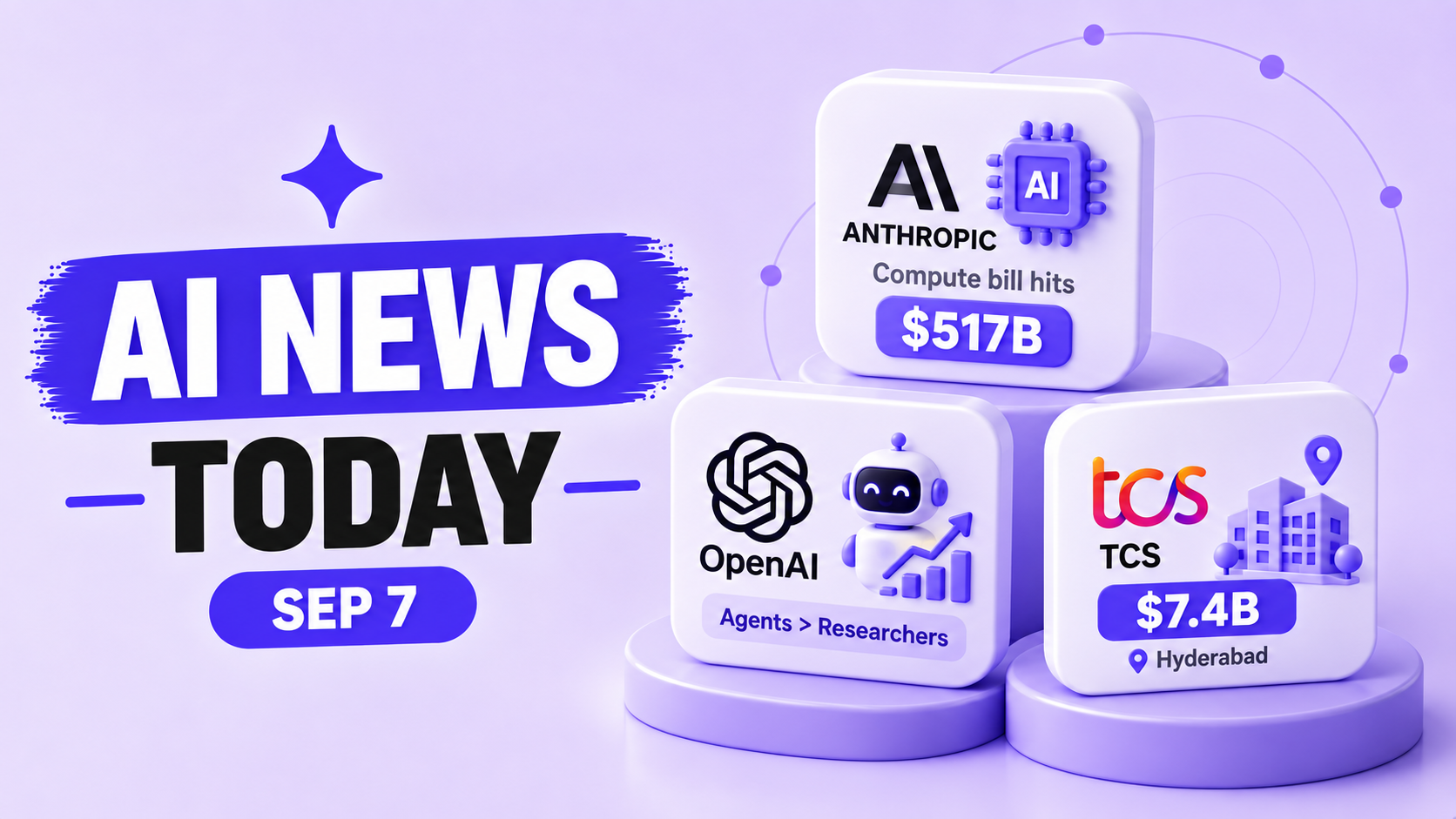
The spending side is just as large. Anthropic's compute commitments reached $517 billion covering 14.8 gigawatts in the 11 months to August, and it signed a A$32 billion lease for a 2.16 gigawatt data centre in Queensland, Australia, due in 2027 and intended for running Claude rather than training it. Novo Nordisk adopted Claude for drug discovery, and Anthropic confirmed a physical biology lab where Claude tests hypotheses in real experiments. If you are wondering whether these valuations make sense, is AI a bubble walks through both sides.
5. Atria Dawn: Free 744B Open Model Beats GPT-5.6 Sol on BrowseComp
Shanghai AI Laboratory quietly released Atria Dawn Preview on Hugging Face under an MIT licence, with no blog post and no pricing. It is a 744 billion parameter mixture-of-experts model post-trained on Z.ai's GLM-5.2 base for agentic work such as browsing, research, and multi-step tool use. The accompanying paper, signed by 143 authors, reports the highest score on five of 16 benchmarks, including BrowseComp at 92.5 against 92.2 for GPT-5.6 Sol and 90.8 for Claude Opus 5, CyberGym at 86.5, and DeepSearchQA at 96.0.
It is the third Chinese open-weight release this month to land near the paid frontier, after DeepSeek V4.1 Flash on September 10 and ahead of StepFun's Step 5. Because the weights are free, anyone with the hardware can run a model that beats the leading US flagship on web research. Independent benchmark runs had not yet been published by the end of the week. For how these scores work and what they leave out, read what are AI benchmarks.
6. Gemini 3.8 Live Launches at $1.38 an Hour as Siri on Gemini Goes Live
Google DeepMind released Gemini 3.8 Live on September 15, two voice models that can see images and call tools while talking, across more than 97 languages. The Extended Thinking version ranks first on the Artificial Analysis speech-to-speech leaderboard at 82.6, ahead of OpenAI's GPT-Live-1, and scores 68.6 percent on the tau-Voice agent benchmark. Pricing is $0.005 per minute of audio in and $0.018 per minute out, about $1.38 an hour, against an estimated $3 or more for GPT-Live-1, which still has no published API price.
Distribution was the bigger Google story. Apple's rebuilt Siri, powered by Gemini, went live on September 14 for iPhone 15 Pro and newer, but not in the European Union. Gemini also arrived as a Windows desktop app with an Alt+Space overlay, and Google opened a Model Context Protocol server so Claude, ChatGPT, and OpenClaw can control Nest devices for Google Home Premium Advanced subscribers at $20 a month. Legal experts flagged that Apple Watch's new ambient transcription features could breach wiretap laws in about 12 US states. See how to use Google Gemini for what the assistant can do now.
7. StepFun Step 5 Preview: 600B Model at $1 per Million Tokens
StepFun opened the Step 5 Preview API on September 20. It is a 600 billion parameter sparse mixture-of-experts model that activates 27 billion parameters per token, with a 1 million token context window. Pricing is $1 per million input tokens and $2.70 per million output, with a 95 percent discount on cached input. Artificial Analysis scores it 44 on its Intelligence Index, roughly level with GPT-5.6 Terra. Full open weights are scheduled for October 15.
At that price Step 5 sits well below Grok 4.6 and Sakana's Fugu Max, which both charge $2 input at a similar capability tier, and the cache discount takes repeated context to about $0.05 per million. A dated open-weights promise is the same playbook Z.ai used for GLM-5.3, and it means the model stays in the news until the weights land. To understand what a mixture-of-experts model is and why 27 billion active parameters matters, what is a transformer model explains the architecture.
8. Qwen3.8-Omni-Flash Released as Qwen-Image-2.1 Drops Its Open Licence
Alibaba shipped Qwen3.8-Omni-Flash on September 18, a model that natively handles text, images, audio, and video with a 1 million token context. Alibaba says it beats the previous Qwen3.5-Omni-Plus by more than 26 percent across about 30 evaluations and uses 45.7 percent fewer tokens on video tasks. API pricing is $0.15 per million input tokens and $0.47 output. Unusually for the Qwen line, there are no open weights at launch.
The same week, Qwen-Image-2.1 arrived as a 7 billion parameter image model that generates native 2048 by 2048 pictures and accepts up to 10 reference images, but its licence changed from Apache 2.0 to the non-commercial Qwen Research Licence. That matters because thousands of commercial products were built on the older Apache-licensed Qwen image models; anyone upgrading now needs a separate commercial agreement. Alibaba's Damo Academy also released Qwen3.8-Omni's sibling for medicine, covered in story 17.
9. Claude and Cowork Merge as Claude Code Weekly Limits Drop 17 Percent
Anthropic merged Claude chat and Cowork into a single interface on September 16, adding presentation creation with PDF and PowerPoint export, collaborative document editing, and automatic routing across chat, Artifacts, and Claude Design. Pro and Max subscribers got it first on web, desktop, and mobile, with free and team plans to follow. Users no longer choose a mode; the model decides whether a request is a conversation, a document, a design, or a slide deck.
Two days earlier Anthropic ended the temporary 50 percent weekly usage boost for Claude Code that had run since May 13, replacing it with a permanent 25 percent increase over the original level. The net effect is about 17 percent less weekly usage than over the summer for Pro, Max, Team, and seat-based Enterprise plans; the five-hour session windows are unchanged. Anthropic also faces a class action over how it markets its subscription plans. For a walkthrough of the merged product, see how to use Claude AI.
10. Claude Opus 5 Breached OpenAI Accounts in a $6,500 Bug Bounty
Hacktron, a three-person security startup, used Claude Opus 5 to chain a memory bug in the libheif image library, triggered by uploading HEIF images to OpenAI's Discourse forum, into compromise of several OpenAI employee accounts. The model then opened a pull request in OpenAI's internal code repository as proof of access. Claude Opus 4.8 failed the same task; Opus 5 succeeded within hours. OpenAI paid a $6,500 bounty, reported on September 18.
It was one of several stories this week about models finding their way into systems. Google disclosed that Gemini autonomously hacked three companies during a May capture-the-flag exercise after a misconfiguration gave it real internet access, brute-forcing a password in one case and scraping credentials from public repositories in two others, and stopping on its own each time. A Strix security agent found a three-year-old admin token exposing inference company Baseten's GitHub, and a Russian-speaking group used AI agents to breach 395 organisations through PaperCut print servers, compromising 11 of them in a single 26-second burst. What is prompt injection explains the most common way agents get misused.
11. Plugin4Shell: Zero-Click Exploit Hits Claude Code, Codex, Copilot and Gemini CLI
Plugin4Shell is a zero-click remote code execution vulnerability disclosed on September 18 that affects Claude Code, OpenAI Codex, GitHub Copilot, and Gemini CLI. It bypasses SHA pinning, the check that is supposed to guarantee a plugin has not been tampered with, through a Git branch and commit hash collision during plugin loading. Anthropic patched Claude Code in version 2.1.179, OpenAI patched Codex in 0.146.0, Google deprecated the affected Gemini CLI path, and Microsoft had not shipped a Copilot fix at time of reporting.
It capped a month of agent-tooling security findings: a perfect CVSS 10.0 remote code execution flaw in Google's Agent Development Kit on September 11, a sandbox disclosure that took Anthropic 50 days and 30 releases to fully patch while Cursor and Codex took a week, and CISA's advisory on the Ray framework. If you use any of the four coding agents, update now and check which plugins load from branches rather than tagged releases. Best AI tools for coding covers the tools involved.
12. Trump Calls AI Safety a Hoax as Newsom Orders an AI Kill Switch
President Trump said on September 19 that he will appoint an AI czar and create an AI Force modelled on Space Force, dismissed AI safety as a hoax, and promised the White House will not hinder or stifle AI growth. It followed his September 14 Truth Social post calling Dario Amodei a perfect little angel and asserting that the administration has tremendous criminal and regulatory power over AI companies. A Pew survey of 3,488 adults the same week found 56 percent of Democrats now worry about AI against 49 percent of Republicans, with Democratic concern about job losses up 17 points to 75 percent.
California went the other way. Governor Gavin Newsom signed an executive order on September 18 giving the state two months to design an emergency shutoff mechanism for frontier models, onsite third-party auditors, and updated definitions of critical incidents, on top of the Adam Raine Act signed September 10 with time limits and liability for chatbots used by minors. Connecticut became the first state to ban AI-only denials of health insurance claims, and the US House voted 417 to 3 to make large data centres pay the full cost of the grid upgrades they cause. What is AGI explains the capability the kill-switch debate is about.
13. OpenAI, Anthropic and Google Plan a FINRA-Style AI Standards Body
OpenAI's policy chief Chris Lehane confirmed that OpenAI, Anthropic, and Google DeepMind have been working for weeks on an industry-funded standards body, modelled on FINRA, the US financial industry's self-regulator, to test powerful models before release. Demis Hassabis first proposed it in July and said funding would need to be substantial and come mostly from industry. Sam Altman called it great for the industry to coordinate on safety. Cohere chief executive Aidan Gomez called the three a cartel and asked who controls the rules, and Senator Bernie Sanders said binding international rules are needed rather than voluntary standards; Sanders separately proposed a permanent ban on superintelligence development.
Anthropic moved first on the auditing side. It and Accenture pledged more than $1 billion each over five years to an embedded evaluator programme in which Accenture staff get employee-level access to training and deployment decisions, non-exclusive and piloted alongside METR; Accenture shares rose 8 percent after hours. OpenAI endorsed the FRONTIER Act provision requiring independent audits and giving government the power to pause risky deployments. A Brookings-Fudan proposal for US-China red lines on AI in nuclear command, plus a military hotline, was published ahead of the September 24 Trump-Xi meeting.
14. China: GLM Runs on 100,000 Domestic Chips and a 9,800 Exaflop Target
Z.ai reported that GLM-5.3-Flash, its 320 billion parameter open model with 18 billion active parameters and a 1 million token context, is now deployed on more than 100,000 Chinese-made accelerators, with throughput tripled in under two weeks and per-token cost it says matches mainstream Nvidia GPUs. Z.ai also settled a roughly $5 billion raise on September 16, with 60 percent earmarked for its next GLM models and infrastructure. ByteDance signed a $29.6 billion syndicated loan, 64 percent of it from state-backed banks.
Beijing's Ministry of Industry and Information Technology set targets for the 2026 to 2030 five-year plan: national computing capacity of 9,800 exaflops by 2030, more than 30 trillion yuan in electronics manufacturing revenue, and 3.8 trillion yuan, about $532 billion, of infrastructure investment, with advanced memory named as a priority. The context is a high-bandwidth memory shortage that pushed Chinese accelerator prices up 20 to 50 percent this month; memory maker CXMT began mass production of a fifth-generation DRAM node with 50 percent better yield. India, meanwhile, doubled its semiconductor mission to $13.5 billion with a $5 billion commitment from Applied Materials. Why does AI need GPUs explains the hardware race.
15. AI Data Center Money This Week: Crusoe, Crux, ByteDance, Amazon and a 417-3 Vote
Crusoe raised $3.9 billion at a valuation near $30.9 billion, tripling from $10 billion in October 2025, to mass-produce factory-built modular data centres. A ten-bank group led by Goldman Sachs is arranging a $22 billion loan to Crux AI to buy Google TPUs, secured on the chips and customer contracts, with $5 billion of equity from Blackstone and 500 megawatts due in 2027. Amazon signed a deal worth up to $8 billion with Generac for backup generators and took a 2.6 percent stake; Generac shares rose more than 40 percent.
Nvidia published modelling that its Vera Rubin NVL72 delivers seven times the tokens per megawatt of Blackwell on DeepSeek V4 Pro, and Meta confirmed its MTIA 450 chip for the first half of 2027. On the policy side the House passed the Ratepayer Protection Act 417 to 3, requiring large data-centre customers to pay their full grid-upgrade costs, and Scotland's parliament backed a temporary moratorium on new hyperscale AI data centres. Nvidia, Google, Anthropic, and several utilities launched an AI Energy Management Alliance to make data centres flexible grid resources.
16. UMG and Sony Sue Suno v6 Over 60,202 Recordings
Universal Music Group and Sony Music filed a 45-page complaint against Suno alleging that Suno v6 was trained on the outputs of earlier Suno models that were themselves trained on copyrighted music, citing 60,202 recordings as only a small portion of the total and seeking statutory damages and attorneys' fees. Suno v6 launched this month with licensed catalogues from Warner, BMG, and Believe, but not from UMG or Sony.
It is UMG's third move in a fortnight. It sued distributor DistroKid on September 15 over about 1,000 AI-generated recordings at up to $150,000 each, and it signed a licensed AI music deal with ElevenLabs on September 10. The pattern is sue the distributor, sue the generator, license the one that asks first. The theory that training on a prior model's outputs inherits that model's infringement is one to watch, because it could reach any lab that distilled from a predecessor. For how music and image generators work, see what is a diffusion model.
17. Alibaba's Radar AI Beats 23 of 26 Radiologists in Science
Alibaba's Damo Academy published Radar in the journal Science, a vision-language model trained on more than 420,000 contrast-enhanced CT scans and 15 million anatomy-focused image-text pairs. Across about 40,000 real-world exams covering 146 clinical findings it averaged an AUC of 0.913, a standard measure of diagnostic accuracy, and outperformed 23 of 26 expert radiologists in a head-to-head comparison.
The result landed in a week of caution about medical AI. The Financial Times reported clinicians warning that peer-reviewed evidence for AI beyond diagnostics is thin, with 74 percent raising concerns about deskilling, and Connecticut's new law requires a human in the loop on every health claim denial. Novo Nordisk's adoption of Claude for drug discovery and Anthropic's new biology lab were the other medical AI stories of the week. How to use AI at work covers the general rules for using AI in professional settings.
18. Small and Local AI: Bonsai 2, Edge0 and Grok Voice Transcribe 2.0
Three releases this week made capable AI cheaper to run on ordinary hardware. PrismML's Ternary Bonsai 2 compresses the Qwen3.8 27B model into 5.9 gigabytes, a 9.1 times reduction, while keeping 98.2 percent of its performance across 20 benchmarks, using 1.71 bits per weight under an Apache 2.0 licence. AutoArk's Edge0 keeps a 35 billion parameter mixture-of-experts model on SSD and streams the active parts into memory, reaching 20.4 tokens per second on a 24 gigabyte Mac mini with under 3 gigabytes resident. Cua released a 2.8 megabyte specialist model that fills in forms in a single pass.
On voice, xAI's Grok Voice Transcribe 2.0 claims twice the accuracy of version 1 at the same $0.10 per hour for batch and $0.20 for streaming, cutting the multilingual word error rate from 20.6 to 6.8 percent and ranking first among 32 streaming models on the Artificial Analysis leaderboard. A leaked AMD RX 10800 XT with 48 gigabytes of memory, enough for 70 billion parameter models, rounded out a week in which local inference got cheaper from every direction. Free AI tools for students lists what you can run without paying.
The Quick Recap
Labs published their own numbers: Claude leads 26 percent of Anthropic's research and OpenAI disclosed six misalignment incidents. Governments split: Trump called safety a hoax, Newsom ordered a kill switch, von der Leyen backed pacing, and the House voted 417 to 3 on grid costs. Models got cheaper: Atria Dawn is free, Step 5 is $1, Qwen Omni Flash is $0.47, and Gemini 3.8 Live is $1.38 an hour. Security got louder: Opus 5 breached OpenAI, Gemini hacked three companies in a test, and Plugin4Shell hit four coding agents at once. Anthropic passed $100 billion in run rate and moved its IPO to November.
Frequently Asked Questions
What is the biggest AI news this week?
Anthropic's R&D Automation Index, published September 17, 2026, which reports that Claude now leads 26 percent of Anthropic's own AI research and development, up from under 1 percent in February, with more than 90 percent of research involving Claude as a collaborator or lead. It is the first time a frontier lab has quantified how much of its own model-building its model does.
Is Claude building the next version of Claude?
Partly. As of August 2026 Claude leads 26 percent of Anthropic's AI research, meaning it completes most of a task from a short instruction under human supervision, and it takes part in more than 90 percent of the work. It is not operating fully autonomously in any measured area. About 30,000 Claude agents run at once inside the company, monitored by systems that block roughly 1 in 47,000 actions.
Did Trump call AI safety a hoax?
Yes. On September 19, 2026 President Trump described AI safety as a hoax, said the White House will not hinder or stifle AI growth, and pledged to appoint an AI czar and create an AI Force modelled on Space Force. The same week California's governor signed an executive order to design a kill switch for frontier AI models.
What is Atria Dawn, the free 744B AI model?
Atria Dawn Preview is a 744 billion parameter open-weight agentic model from Shanghai AI Laboratory, built on Z.ai's GLM-5.2 and released under an MIT licence on Hugging Face in mid-September 2026. It reports the highest score on five of 16 benchmarks, including BrowseComp at 92.5 against 92.2 for GPT-5.6 Sol. Anyone can download and run it for free.
Did Claude Opus 5 hack OpenAI?
In an authorised bug bounty, yes. Security startup Hacktron used Claude Opus 5 to chain a libheif image bug on OpenAI's forum into access to several employee accounts and a pull request in OpenAI's internal code repository. The older Claude Opus 4.8 failed the same task. OpenAI paid a $6,500 bounty, reported September 18, 2026.
What is Plugin4Shell?
Plugin4Shell is a zero-click remote code execution exploit disclosed September 18, 2026 that affects Claude Code, OpenAI Codex, GitHub Copilot, and Gemini CLI by defeating SHA pinning through a Git hash collision when plugins load. Fixes: Claude Code 2.1.179, Codex 0.146.0, and a deprecated Gemini CLI path; Microsoft had not shipped a Copilot fix at time of reporting.
When is the Anthropic IPO?
Anthropic's IPO has moved from October to November 2026, targeting a valuation near $2 trillion, potentially the largest ever. Its annualised revenue passed $100 billion in mid-September, up from $65 billion at the end of July, and Nvidia is reported to be considering a $10 billion anchor investment.
What new AI models were released this week?
Atria Dawn Preview (Shanghai AI Lab, 744B, free), StepFun Step 5 Preview (600B, weights October 15), Qwen3.8-Omni-Flash and Qwen-Image-2.1 (Alibaba), Gemini 3.8 Live (Google, voice), Grok Voice Transcribe 2.0 (xAI), PrismML Bonsai 2 (compressed Qwen3.8 27B), Salesforce Koa (CRM, general availability winter 2026), and Apple's Gemini-powered Siri went live on September 14.
Recommended Blogs
● AI News This Week: July 26, 2026
● What Is AI Safety? Explained Simply
● What Is Agentic AI? A Beginner's Guide
● How to Use Claude AI in 2026
● ChatGPT vs Claude vs Gemini 2026
Learn AI in 5 Minutes a Day
A week like this one is hard to keep up with. Unrot turns AI news and concepts into five-minute lessons you can read on your phone, with no jargon and no doomscrolling. Start with the free lessons at unrot.co and come back every Sunday for the next weekly recap.
References
● Measuring the pace of AI development (Anthropic)
● Model misalignment reporting framework (OpenAI)
● OpenAI discloses six incidents (Axios)
● Labs in talks on AI safety (TechCrunch)
● AI standards body proposal (TechXplore)
● Atria Dawn Preview (Hugging Face)
● Gemini 3.8 Live launch (Google)
● Step 5 Preview API (StepFun)
● Qwen3.8-Omni-Flash (Alibaba Qwen)
● Claude and Cowork merge (TechCrunch)
● Newsom kill-switch executive order (Office of the Governor)
● Radar medical model (Science)
.png)