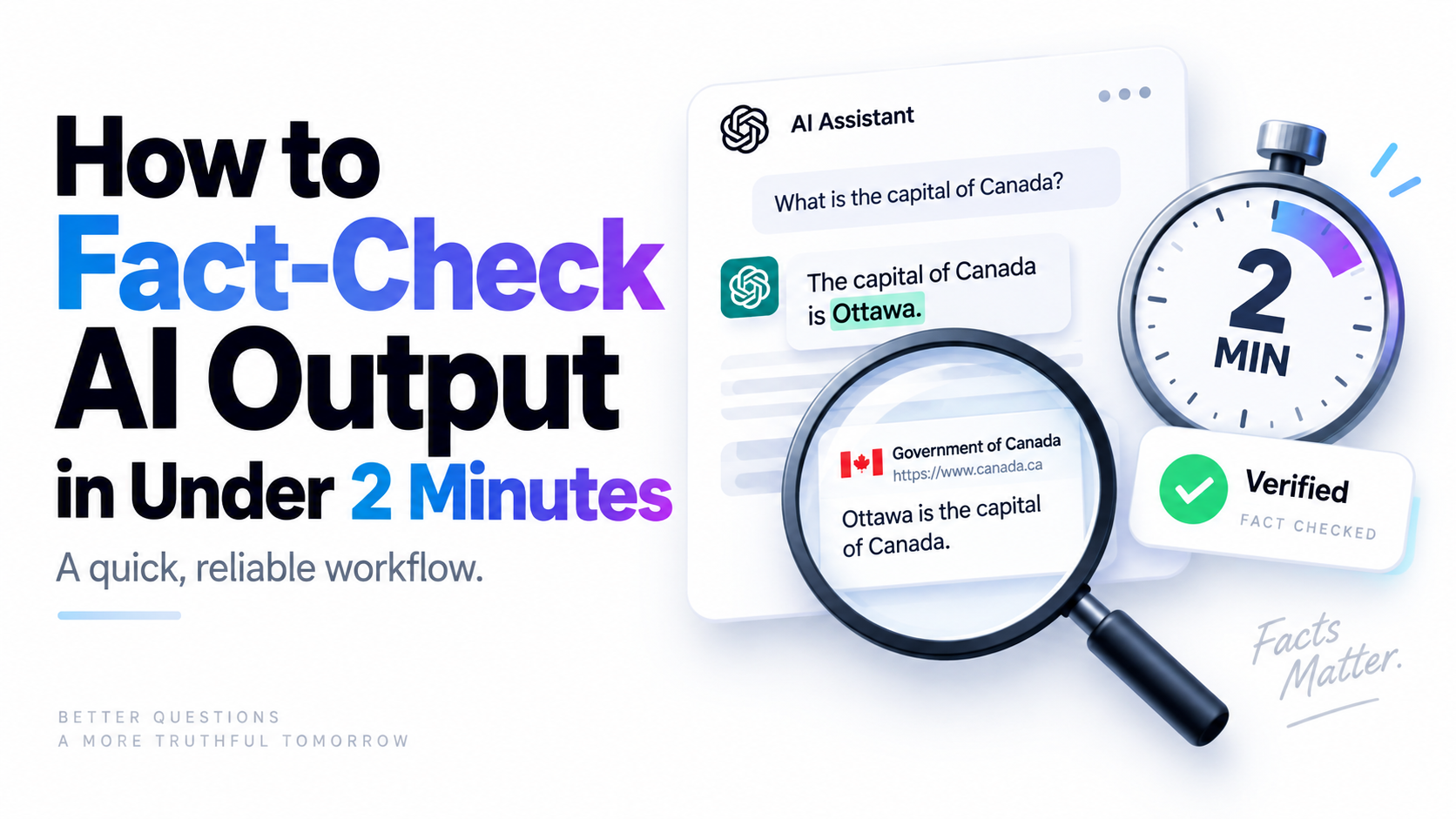
How to Fact-Check AI Output in Under 2 Minutes
A lawyer once cited six court cases in a federal filing. All six were fake. A chatbot had invented them, complete with case numbers, judges, and quotes, and the lawyer submitted them without checking. That is the risk in one sentence. So here is how to fact-check AI in under two minutes, every time, before a made-up fact becomes your problem.
I run AI answers through the same quick routine dozens of times a week. It is not paranoia. It is a habit, like checking your mirror before you change lanes. The tools are genuinely useful, and I use them all day. I just never let a specific claim leave my screen without one fast check.
The good news: you do not need to verify everything. You need to verify the one claim the answer stands on. Learn to spot that claim, learn where to check it, and you can clear most AI output in about ninety seconds.
Why you must fact-check AI
AI models do not know facts. They predict the next likely word based on patterns in their training data, which means a smooth, confident sentence and a completely invented one look identical to the model. That gap between fluency and truth is the whole problem, and it is exactly why AI answers are wrong more often than their tone suggests.
The industry word for a confident false output is an AI hallucination. The model is not lying, because lying needs intent. It is filling a gap in its knowledge with the most plausible-sounding text it can generate, and plausible is not the same as correct. A fake statistic reads exactly like a real one.
Two structural limits make this worse. First, the training cutoff: every model was trained on data up to a certain date, so it has no native knowledge of anything after that unless it can search the live web. Ask about last week and a model without live access will still answer, often by guessing. Second, precision: models are weakest on exact numbers, dates, names, prices, and direct quotes, the very things people most want to copy and paste.
Here is my opinion, and it is not a popular one with the AI-is-magic crowd. The confidence is the danger, not the errors. A tool that sometimes says "I am not sure" would be safer than one that is wrong with a straight face. Until models reliably flag their own uncertainty, the checking is your job. If you want the deeper mechanism, why ChatGPT makes up facts breaks down the token prediction that causes it.
It helps to picture what the model actually did to produce your answer. It did not open a database and look up a value. It generated a sentence one word at a time, each word chosen because it fit the pattern of the words before it. On a topic with thousands of consistent examples in its training, that pattern lands on the truth. On a thin or obscure topic, the pattern still produces a smooth sentence, but now the sentence is a well-formed guess. Same mechanism, wildly different reliability, and no visible warning telling you which one you got.
People assume newer and bigger models will make this go away. They reduce it, and I am glad they do, but they do not remove it, because the cause is the design, not a bug to be patched. A predictive text engine that never guesses would refuse to answer half the questions people ask it, and no company ships that product. So the checking stays your job for the foreseeable future, and treating it as permanent rather than temporary is the healthier mindset.
Quotable line: a language model optimizes for sounding right, not for being right, and those two goals only overlap by accident.
The 2-minute fact-check method
Here is the routine, start to finish. It is one method, repeatable, and it works on ChatGPT, Gemini, Claude, or any chatbot. The point is not to check every word. The point is to find the load-bearing claim and test it.
- Find the load-bearing claim (15 seconds). Read the answer and ask: what single fact is everything else resting on? Usually it is a number, a name, a date, a law, or a quote. That is your target. Ignore the fluff around it.
- Ask for the source (20 seconds). Type: "What is your source for that specific claim? Give me the title, author, and date, and a link if you have one." A model that has a real basis will produce it. A model that hallucinated will stall, hedge, or invent a citation. That reaction is itself a signal.
- Verify the one claim (60 seconds). Open a new tab. Search the exact claim, or the cited source title, in Google. If the source is academic, search it in Google Scholar. Does the source exist? Does it actually say what the AI claimed? Match the number to the number, the quote to the quote.
- Decide (10 seconds). If the claim checks out against a primary source, keep the answer. If the source does not exist, does not say that, or you cannot find any independent confirmation, throw the claim out and treat the rest of the answer with suspicion.
That is it. Roughly one hundred and five seconds if you are quick, and it collapses to thirty when the claim is easy to look up. I have caught fake court cases, invented statistics, and misattributed quotes this way, and none of it took real effort. It took a habit.
One refinement I swear by: verify against a primary source, not a second AI. Asking ChatGPT to check ChatGPT is two guesses stacked on each other. Go to the original study, the official page, the actual news report. Primary sources end the argument.
A question I get often: what if the answer has three or four load-bearing claims, not one? Then you check the riskiest one first, the claim that carries the most weight or would do the most damage if it were wrong. If that claim fails, you are usually done, because a model that fabricated the headline number rarely got the supporting details right. If it holds, spend another thirty seconds on the next most important claim. You are triaging, not auditing, and triage is what keeps this to two minutes instead of twenty.
Build the habit until it is automatic. I do not decide to fact-check anymore, any more than I decide to check my mirror. The claim appears, the new tab opens, the search runs, and I move on. That reflex is the real deliverable of this article. A method you have to remember to use is a method you will skip on the day it matters most, which is exactly the day you are tired, rushed, and about to paste a number into something important.
Quotable line: you do not fact-check the whole answer, you fact-check the one claim the answer cannot survive without.
The red flags that mean stop and verify
Most AI output is low-stakes and roughly fine. The skill is knowing which sentences to distrust on sight. Certain patterns should trigger the check every single time, no exceptions. When you see these, stop and verify before you use, share, or paste the claim anywhere.
Specific numbers are the biggest one. A model will happily tell you a market was worth 47.3 billion dollars in 2024, and that exact-looking figure may be pure invention. Precise statistics with no cited source are guilty until proven innocent. Direct quotes are the second trap: models misattribute quotes constantly, giving Einstein or Gandhi lines they never said.
Citations are the most dangerous of all, because a fake citation looks more credible than no citation. Recent events are a red flag because of the training cutoff. And anything legal, medical, or financial deserves the check by default, since the cost of being wrong is measured in fines, health, or money, not embarrassment.
| Red flag in the AI output | How to check it in seconds |
|---|---|
| A precise statistic (a percentage, a dollar figure, a ranking) | Copy the number and search it in quotes. If no reputable source shows it, discard it. |
| A direct quote attributed to a named person | Search the exact quoted phrase. Real quotes have a traceable original. Fabricated ones do not. |
| A citation to a study, paper, book, or court case | Search the title in Google Scholar or Google. If it does not exist, the whole claim collapses. |
| Any claim about a recent event or new release | Do a fresh news search. The model may be past its training cutoff and guessing. |
| Legal, medical, or financial advice or facts | Verify against an official source (a court site, a health authority, a regulator) before acting. |
| A confident answer to a question with no clear public answer | If the web has no answer, the model invented one. Treat certainty as a warning, not comfort. |
Notice the pattern. Every red flag is a place where being specific and being wrong overlap. Vague generalities are usually safe, because the model is averaging over a lot of text. It is the crisp, quotable, copy-pasteable detail that fails, and that is the exact detail you most want to trust.
Quotable line: the more precise and confident an AI claim sounds, the more it deserves a thirty-second check, not less.
How to make AI cite its sources
Half the battle is won by forcing the model to show its work up front, so you are not reverse-engineering a claim after the fact. The prompt you use decides how checkable the answer is. Ask for a plain answer and you get plain confidence. Ask for sources and you get something you can test.
These are the prompts I keep on hand. Paste one before or after the question:
- "Answer, then list every factual claim with its source. Mark anything you are not certain about."
- "Only use information you can attribute to a named, real source. If you do not have a source, say so instead of guessing."
- "Give me the title, author, publication, and year for each source, and a link if one exists."
- "Rate your confidence in each claim from low to high, and tell me which claims I should verify myself."
These prompts do not make a model honest, and I want to be blunt about that. A model can invent a source in the exact format you asked for, author, year, link, and all. What the prompts buy you is structure. A cited answer is far faster to check than a wall of assertions, because now you have specific targets instead of a vibe. The prompt turns an unverifiable paragraph into a checklist.
The bigger fix is to use a tool built to cite. Perplexity answers with numbered citations attached to each sentence, pulled from live web pages, so you can click straight to the source and confirm. That design does not remove errors, but it removes the guessing about where a claim came from, which is most of the friction. If you have not used it, how to use Perplexity AI walks through it. The general technique of grounding answers in retrieved documents is called retrieval augmented generation, and what is RAG explains why it cuts hallucinations without eliminating them.
One warning about cited tools, because I have watched it fool people. A citation being present is not the same as a citation being correct. A tool can attach a real, live link next to a claim that the linked page does not actually support, because the model summarized the page loosely or pulled the wrong line. So the click still matters. Open the source and confirm it says the specific thing, rather than trusting that a link near a sentence proves the sentence. A citation is an invitation to check, not the check itself.
Quotable line: a prompt cannot force a model to be truthful, but it can force the model to be checkable, and checkable is enough.
Lateral reading: the technique fact-checkers use
Professional fact-checkers do not do what most people do. When an ordinary reader hits a questionable claim, they read further down the same page, looking for reassurance. Fact-checkers do the opposite. They leave the page immediately and open new tabs to see what other, independent sources say about the claim or the source. That move has a name: lateral reading.
Reading down a single page is vertical reading, and it is how you get fooled, because a page that is wrong or biased will happily keep telling you it is right. Reading across many pages is lateral reading, and it is how you get the truth, because independent sources rarely repeat the same specific invented detail. This applies perfectly to AI. The chatbot reply is one page. Do not read deeper into it. Read across from it.
In practice, lateral reading of an AI answer looks like this. You take the key claim, you open a new tab, and you ask the open web: who else says this, and do they agree? If three independent, reputable sources confirm the number, you are safe. If the only place that number appears is the chatbot, you have your answer. It was invented.
I find this reframing changes how people treat AI overnight. Once you see the chatbot as one source to be corroborated rather than an oracle to be trusted, the two-minute check stops feeling like extra work and starts feeling obvious. You would not publish a stranger's claim without a second source. An AI is a very fluent stranger.
There is a subtle version of lateral reading worth naming, because it catches the errors the obvious version misses. When you search a claim and find it repeated on ten sites, do not stop there. Ask whether those ten sites are actually independent or whether they all copied one original, which may itself be wrong. Real corroboration means separate sources that did their own reporting or research, not ten blogs echoing the same press release. This matters even more now that many of those blogs are themselves AI-written and may have repeated the same hallucination.
Quotable line: fact-checkers do not read deeper into a suspect source, they read away from it, and that single habit catches most AI hallucinations.
Tools that speed this up
The right tool turns a two-minute check into a thirty-second one, so it is worth knowing which tool does which job. Each of these has one thing it is best at, and using the wrong one is why checking feels slow.
Perplexity is the fastest for source-backed answers. Because it cites as it writes, you can verify a claim by clicking the citation rather than running a fresh search. I use it as my first stop whenever I need something I will later have to defend. It is a search engine and an answer engine at once.
Google is still the workhorse for lateral reading. Search the exact claim in quotation marks to find its original source, or search it without quotes to see the range of what reputable sites say. When a precise statistic returns zero credible results, that silence is the finding.
Google Scholar is the one that catches fake academic citations, and it is the tool most people forget. If an AI cites a study, paper, or author, search the title in Scholar. Real research is indexed there. A fabricated paper is not, and that absence is proof.
Reverse image search handles the visual side. If an AI or an article hands you an image as evidence, drop it into Google Images or a reverse image tool to find where it really came from and when. AI-generated and out-of-context images fall apart under this fast.
My honest ranking: for text claims, Perplexity first, Google second, Scholar for anything academic. I reach for reverse image search less often, but when a claim rests on a photo, nothing else does the job. None of these are hard to use, and building the reflex to open one is the entire skill. The same discipline pays off when you use AI at work, where an unchecked number can end up in a deck in front of your boss.
Quotable line: Perplexity tells you where a claim came from, Google tells you who else agrees, and Scholar tells you whether a cited study is real.
When AI is usually safe versus risky
You cannot fact-check everything, and you should not try, so the real skill is calibrating effort to stakes. Not every AI answer needs the full routine. Knowing when to relax and when to lock in is what makes the habit sustainable instead of exhausting.
AI is usually safe for tasks where there is no single external fact to get wrong. Rewriting your email in a friendlier tone, brainstorming names, drafting an outline, summarizing text you paste in, explaining a general concept you can sanity-check yourself, writing code you will run and test anyway. In these cases the output is a starting point you control, and an error surfaces immediately when you read or run it.
AI is risky the moment the output contains a specific external fact you plan to rely on or repeat. A statistic in a report. A citation in an essay. A legal, medical, or financial claim. A quote you will attribute publicly. Anything about a recent event. Anything where you would look foolish, or worse, be liable, if it turned out to be invented. That lawyer with six fake cases was on the risky side and treated it like the safe side.
My rule of thumb, and I hold to it: if I would not stake my name on it, I check it. If I am the only one who will ever see the output and I can catch the error myself, I usually do not. That single question, would I stake my name on this, sorts almost every AI answer into check or skip faster than any checklist.
There is one more factor that quietly moves an answer from safe to risky: how obscure the topic is. A model is safest on questions that appear thousands of times in its training, like basic history, common definitions, or popular programming patterns. It is most dangerous on narrow, specialized, or brand-new questions, where it has little to pattern-match against and fills the gap with confident invention. If you are asking about something niche, treat even a plain-sounding answer as risky, because obscurity is where hallucination lives.
Quotable line: AI is safe for drafts you control and risky for facts you repeat, and the line between them is whether an error would be yours to own.
A worked example: catching a fake citation
Let me show you the routine on a real-feeling case, because the abstract version never lands until you see it work. Suppose you ask a chatbot for evidence that microlearning improves retention, and it replies with this: "A 2019 study by Dr. Karen Whitfield at Stanford, published in the Journal of Educational Psychology, found that microlearning improved knowledge retention by 22 percent compared to traditional lectures."
That answer is dangerous precisely because it is perfect. It has an author with a title, a named university, a real-sounding journal, a year, and a clean statistic. It is exactly what you wanted to hear, which is the first warning. When an answer is suspiciously convenient, slow down.
Run the method. The load-bearing claim is the study itself, the 22 percent figure resting on that specific paper. So you search the title and author in Google Scholar. If no such paper by Karen Whitfield appears, that is your answer: the citation is fabricated. Next, search the exact phrase "improved knowledge retention by 22 percent" in Google. If the only place that number lives is the chatbot, it was invented. Finally, check whether the Journal of Educational Psychology even publishes on that topic in that way, and whether a real, different study supports the general point.
Here is the trap most people fall into. The underlying claim, that microlearning helps retention, is broadly supported by real research. So the AI is directionally right and specifically fake. It hallucinated a precise citation to dress up a real idea, and that is the most common failure mode I see. You catch it not by disagreeing with the conclusion but by testing the evidence, and the evidence, the named study, is what does not exist.
I have watched this exact pattern fool smart people, because the instinct is to check whether the claim sounds true rather than whether the source is real. Flip that instinct. Check the source first. A fabricated study attached to a true-sounding claim is the signature move of an AI hallucination, and Google Scholar unmasks it in about twenty seconds.
Quotable line: an AI will attach a fake citation to a real idea, so check whether the source exists before you check whether the claim feels right.
Frequently Asked Questions
How do I fact-check ChatGPT quickly?
Find the one claim the answer depends on, usually a number, name, date, or quote, then ask ChatGPT for its source and verify that source in a fresh Google or Google Scholar search. The whole check takes under two minutes. If the source does not exist or does not say what was claimed, discard the answer.
Is ChatGPT accurate enough to trust for research?
ChatGPT is accurate enough to draft and outline, not to be your final source. It is strong on well-documented general topics and weak on precise numbers, recent events, and citations. Use it to speed up research, then verify every specific fact against a primary source before you rely on it.
What is an AI hallucination, exactly?
An AI hallucination is a confident output that is factually false or entirely invented, like a fake study, a wrong statistic, or a quote no one ever said. It happens because a language model predicts plausible text rather than retrieving verified facts, so a made-up sentence looks identical to a true one.
How can I tell if an AI made up a source?
Search the source title and author in Google Scholar for academic work, or in Google for anything else. A real source has a traceable original with a matching title, author, and date. If the paper, book, or article does not appear anywhere except the chatbot, it was fabricated, which happens often with precise-looking citations.
Can I trust AI for medical or legal questions?
Treat every medical, legal, or financial answer as risky and verify it against an official source before acting, such as a health authority, a court website, or a regulator. In 2023 a lawyer was sanctioned for filing six AI-invented court cases. The cost of a wrong answer in these areas is far higher than the two minutes a check takes.
Which tool is best for checking AI sources?
Perplexity is the fastest because it attaches numbered citations to each claim, so you click straight to the source instead of running a new search. Use Google for lateral reading across independent sources and Google Scholar to confirm academic citations. For image-based claims, use reverse image search to find the original.
Does asking AI to double-check its own answer work?
Not reliably. Asking a model to check itself stacks one guess on another and can produce a confident correction that is also wrong. It sometimes catches obvious slips, but it is no substitute for checking against an independent primary source. Verify with a real source, not a second AI reply.
How long should fact-checking an AI answer take?
About two minutes for a normal claim, and closer to thirty seconds once the habit forms and the claim is easy to look up. You are not checking every word, only the single load-bearing claim, so the effort stays small. The routine is fast enough to run every time without slowing your work down.
Recommended Blogs
What Is RAG (Retrieval Augmented Generation)
Unrot teaches you how to use AI well, and how to catch it when it is wrong, in 5 minutes a day. Start free at unrot.co.
References
Image Suggestions
Below the intro: a split screen, a confident chatbot reply on the left, a browser tab verifying it on the right. Alt text: how to fact-check AI output by verifying a claim in a second tab. Filename: fact-check-ai-split-screen.png
In the 2-minute method section: a four-step flow diagram, find the claim, ask for the source, verify, decide. Alt text: the 2-minute AI fact-check method in four steps. Filename: 2-minute-ai-factcheck-method.png
In the red flags section: a checklist graphic of six AI red flags with warning icons. Alt text: six red flags in AI output that mean stop and verify. Filename: ai-output-red-flags-checklist.png
In the tools section: logos and one-line jobs for Perplexity, Google, and Google Scholar side by side. Alt text: tools to fact-check AI, Perplexity, Google, Google Scholar. Filename: ai-factcheck-tools-comparison.png
In the worked example: a mock chatbot answer with a fake citation circled in red. Alt text: catching a fake AI citation in a chatbot answer. Filename: fake-ai-citation-example.png