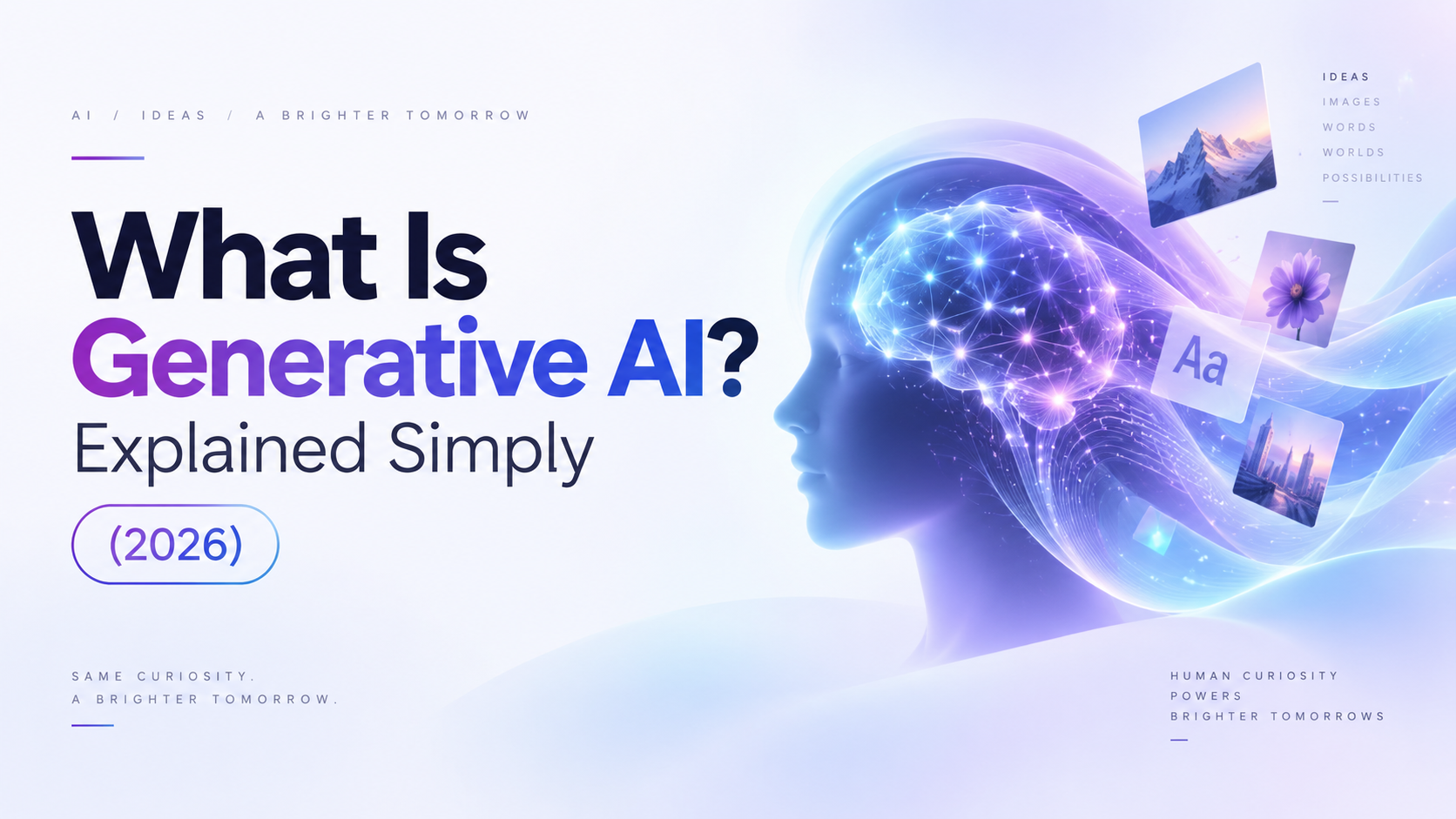
What Is Generative AI? Explained Simply (2026)
You have used generative AI even if you have never used that exact phrase. Every time ChatGPT writes an email for you, Midjourney turns a sentence into a picture, or Suno composes a song from a prompt, generative AI is the technology doing the work. It is the single term that connects most of the AI products people talk about in 2026, and it is worth actually understanding rather than just recognizing. This guide explains what generative AI is, how it works under the hood, the different types in use today, and where it already shows up in daily life.
What Is Generative AI, in One Sentence?
Generative AI is a type of artificial intelligence that creates new content, text, images, audio, video, or code, by learning patterns from huge amounts of existing data and using those patterns to produce something new rather than simply sorting, labeling, or retrieving information that already exists. That single distinction, generating new output instead of processing existing input, is what separates it from most AI that came before it.
Older AI systems were mostly built to answer narrow, closed questions: is this email spam, what object is in this photo, will this customer cancel their subscription. Generative AI flips the task around. Give it a prompt, and it produces something that did not exist a moment earlier: a paragraph, a painting, a melody, a block of working code.
How Does Generative AI Actually Work?
Generative AI models learn by studying enormous datasets, text scraped from the internet and books, millions of images, hours of audio, and identifying the statistical patterns in how that data is structured. A language model like GPT or Claude learns which words tend to follow other words in which contexts. An image model like Midjourney or Stable Diffusion learns how pixels relate to each other to form recognizable shapes, textures, and styles.
Once trained, the model does not store or look up specific answers. Instead, when you give it a prompt, it calculates, step by step, what the most statistically likely next piece of output should be, whether that is the next word in a sentence or the next stage of removing noise from a random field of pixels until an image emerges. This is why the same prompt can produce slightly different results each time, and why the model can produce something genuinely new rather than a copy of something it saw during training.
Most modern text-based generative AI, including ChatGPT, Claude, and Gemini, runs on an architecture called the transformer, introduced in a 2017 Google research paper. Most image and video generators, including Midjourney and Sora, rely on a different technique called diffusion, which starts with random noise and gradually refines it into a coherent image.
The Main Types of Generative AI
Generative AI is not one tool. It spans several distinct categories, each suited to a different kind of output.
- Text generation: Large language models like ChatGPT, Claude, and Gemini write essays, answer questions, summarize documents, and generate code.
- Image generation: Diffusion-based tools like Midjourney, DALL-E, and Stable Diffusion turn written descriptions into original images and artwork.
- Video generation: Tools like Sora and Runway generate short video clips from text prompts or a single reference image.
- Audio and music generation: Tools like Suno and ElevenLabs compose original music or generate realistic speech from text.
- Code generation: Tools like GitHub Copilot and Claude Code write, complete, and debug software based on natural language instructions.
Generative AI vs. Traditional AI: What's the Difference?
Traditional AI, sometimes called discriminative or predictive AI, is built to classify, sort, or predict based on existing categories. A spam filter deciding whether an email is junk, a fraud detection system flagging a suspicious transaction, and a recommendation engine suggesting your next Netflix show are all traditional AI. They choose between existing options; they do not create anything new.
Generative AI does the opposite. It produces output that did not exist before the prompt was given. The technical difference comes down to what the model is trained to do: a traditional model learns to answer "which category does this belong to," while a generative model learns to answer "what comes next," which lets it construct entirely new content one piece at a time.
Generative AI vs. Agentic AI
These two terms get confused constantly, and the difference matters. Generative AI answers your questions and creates content when you ask it to. Agentic AI goes further: it takes that same underlying model and gives it the ability to plan multiple steps, use tools like browsers and code execution, and complete tasks with minimal supervision, actually booking the flight instead of just describing how you might book one. Most of the "AI agents" making headlines in 2026 are generative models wrapped in a system that lets them act, not a fundamentally different kind of AI.
Real-World Examples of Generative AI
Generative AI has moved well past chatbots and into daily workflows across nearly every industry.
- Writing and communication: Drafting emails, reports, and marketing copy with tools like ChatGPT and Claude.
- Design and marketing: Generating product mockups, ad creative, and social media graphics with Midjourney or Adobe Firefly.
- Software development: Writing and reviewing code with Claude Code, Cursor, and GitHub Copilot.
- Customer service: Powering chatbots that draft or fully handle customer replies.
- Healthcare and research: Drafting clinical notes, summarizing medical literature, and assisting drug discovery research.
- Entertainment: Composing music, generating game assets, and producing short-form video content.
How Big Is Generative AI Right Now?
The scale is genuinely unusual for a technology this young. According to Stanford HAI's 2026 AI Index, generative AI reached 53 percent of the global population within three years of ChatGPT's launch, a faster adoption curve than the personal computer or the internet. ChatGPT itself reached 100 million users within roughly two months of its late 2022 release, a speed no consumer product had matched before it.
Market size estimates vary widely depending on what analysts count, ranging from roughly 30 billion dollars to well over 100 billion dollars for 2026 alone, but the direction is not in dispute: Bloomberg Intelligence and Goldman Sachs project the generative AI market could reach 1.3 trillion dollars by 2032, driven by enterprise adoption, multimodal models, and AI agents built on top of generative foundations.
What Are the Risks and Limitations of Generative AI?
Generative AI's biggest limitation follows directly from how it works. Because it generates the statistically likely next word or pixel rather than retrieving verified facts, it can produce confident, well-written answers that are simply wrong, a problem commonly called hallucination. It can also reproduce biases present in its training data, raise copyright questions when it closely echoes existing work, and be used to generate convincing misinformation, fake images, or deepfakes at a scale that was not previously possible.
None of this makes the technology unusable. It means treating generative AI output the way you would treat a very well-read but occasionally overconfident assistant: useful for a first draft, a starting point, or a creative option, but worth verifying before it goes anywhere that matters.
Quick Recap
- Generative AI creates new content, text, images, audio, video, or code, by learning patterns from data rather than simply sorting or classifying existing information.
- Most text models run on transformer architecture; most image and video models run on diffusion techniques.
- It differs from traditional AI, which classifies and predicts, and from agentic AI, which acts autonomously using generative models as a base.
- It reached 53 percent global adoption within three years, faster than the PC or the internet.
- Its main limitation is hallucination: confident-sounding output that is not always accurate, which is why verification still matters.
Frequently Asked Questions
What is generative AI in simple terms?
Generative AI is artificial intelligence that creates new content, like text, images, audio, or code, by learning patterns from large amounts of existing data and using those patterns to produce something original, rather than simply retrieving or sorting information that already exists.
What is an example of generative AI?
ChatGPT, Claude, and Gemini for text, Midjourney and DALL-E for images, Sora for video, and Suno for music are all examples of generative AI. Each takes a prompt and produces new content in response.
What is the difference between generative AI and traditional AI?
Traditional AI classifies or predicts using fixed categories, like flagging spam or recommending a show. Generative AI creates new content that did not exist before the prompt, like writing an original paragraph or painting.
What is the difference between generative AI and agentic AI?
Generative AI creates content when asked. Agentic AI takes that same kind of model and adds the ability to plan, use tools, and complete multi-step tasks with less supervision, actually carrying out an action rather than just describing it.
Is ChatGPT generative AI?
Yes. ChatGPT is a large language model, a form of generative AI that produces original text responses by predicting the most likely next word based on patterns it learned during training.
What are the risks of generative AI?
The main risks include hallucination, confident but incorrect output, bias inherited from training data, copyright concerns, and misuse for misinformation or deepfakes. These risks make verification an important habit rather than a reason to avoid the technology.
Recommended Blogs
What Is Agentic AI? A Beginner's Guide
What Is a Large Language Model? (Explained Simply)
What Is a Transformer Model? Explained Simply (2026)
What Is a Diffusion Model? How AI Makes Images (2026)
What Is Machine Learning? The Guide That Actually Makes Sense
Learn AI in 5 Minutes a Day
Keeping up with AI does not require reading every release note yourself. Unrot delivers the day's biggest AI developments in a 5 minute daily lesson, written in plain English for beginners, students, and working professionals who want to stay current without the jargon.
References
Generative artificial intelligence, overview
Stanford HAI 2026 AI Index, adoption data
Generative AI Market Size 2026: Trends, Growth and Forecast